Introduction
This section documents the Information Capabilities that are used in the ShareAspace D2M product. The Information Capabilities are documented:
- at a business level by Capabilities
- at an implementation level by SoftTypes
Information capabilities
The ShareAspace product provides a set of business capabilities where each capability is intended provide information and functionality to support the management of a particular stage in a product lifecycle or business area.
These are documented in the capabilities section. The documentation for each capability includes:
- overview
- feature summary
- business processes that are supported by the capability
- information scope
- list of support SoftTypes
Business processes
Where appropriate, a set of high level business processes that a capability supports are documented. This is done using high level activity diagrams. The intention is not to provide a detailed process, but rather an indication of the type of business process supported by the capability.
Information scope
The information scope section provides a high level overview of the information that is managed by a capability. This is done by using a high level information model modelled using simple UML class diagrams of business objects.
Each business object results in a ShareAspace configuration artefact. Either:
- one or many SoftType
- one or many SoftType part
- one or many Generic SoftType
There is normally a one to one correspondence between a business objects and a configuration artefact.
The following conventions are used in documenting the business objects.
Naming of properties
Business object properties named in a plural form mean that the requirement is to have an array.
Business object properties named in a singular form mean that the requirement is to have at least one.
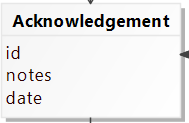
Associations
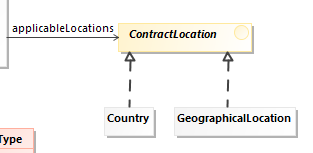
Shared associations (arrow with a black diamonds at the source) between 2 business scope objects mean that the target object is part of the source object.
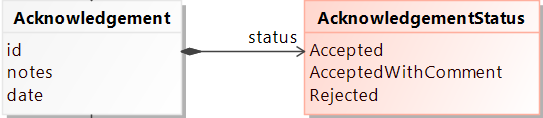
Pure associations (straight line arrow) between 2 business scope objects mean a reference to the target object.
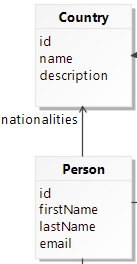
Display conventions
When an object is displayed for the first time in a diagram it is displayed with all its properties and associations. This diagram is the main diagram for this object.
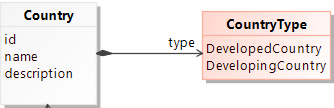
When an object is used in a diagram outside the main diagram object it is displayed as a simple box without any properties.
SoftTypes
SoftTypes are documented using the following:
Model usage guides
Model usage guide diagrams are provided as a guideline on how the configuration artefacts e.g. SoftTypes have been implemented and relate to other SoftTypes.
They are modelled as SysML block diagrams.
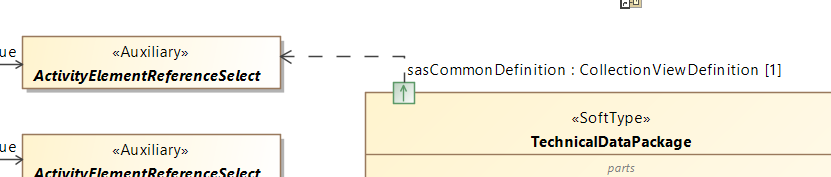
Usage associations
In the Model usage guide diagrams, we have used dependencies to indicate how a property, a port or a SoftType should be used in the context of an association to an other SoftType.
Display conventions
In the same manner as for the Business object diagrams, when a configuration artefact is used outside its main diagram it is normally displayed as a simple box.
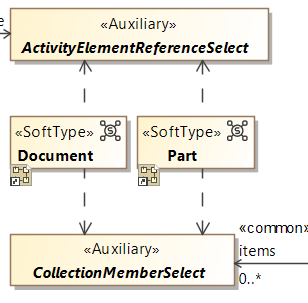
Objects (other than enumerations) displayed without their stereotype icons are objects from the ShareAspace model directly.
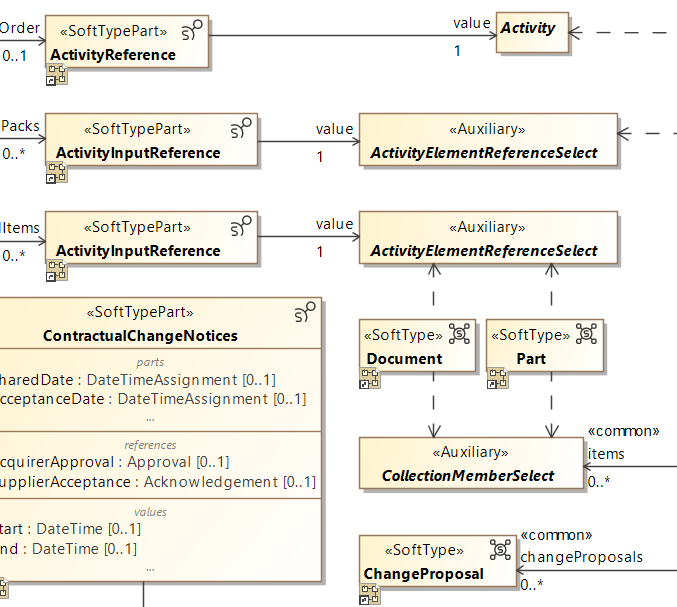
SoftType diagrams
SoftType diagrams are SysML block definition diagrams that just show the SoftType itself.
Note
Those diagrams are not strictly following the SysML convention, some "freedom" have been taken to make those diagrams in a way "simpler to read".
SoftType schemas
By default, all SoftTypes have a defaultIn and defaultOut schema that expose a minimum set of ports that are most commonly used.
They also have a maxIn and maxOut schema that expose every ports and group from the data section.